
Top Lithium Stocks 2026: The New Battery Leaders
Unveiling the Future of Energy: Key Lithium Stocks Powering Innovation in 2026

The lithium market has matured. We aren’t just talking about mining raw materials anymore; we are talking about the technology that makes those materials useful. The energy storage revolution has moved from a “land grab” for resources to an “arms race” for efficiency, density, and domestic security.
For investors, this shift changes everything. The biggest gains in 2026 won’t necessarily come from the companies pulling brine out of the ground. They will come from the innovators perfecting the battery cell itself.
Two companies currently stand out as top lithium stocks 2026 has to offer: Amprius Technologies (AMPX) and Dragonfly Energy (DFLI). One is rewriting the laws of physics for aerospace, while the other is rebuilding the American supply chain for industrial power.
Here is why these two stocks should be on your radar.
Upgrade to Paid — 3 weekly insights, full archive access, and advanced frameworks. The annual plan is nearly cost-free
The Shift from Mining to Manufacturing
To understand the opportunity, you have to look at the bottleneck. For years, the bottleneck was raw lithium. Now, as supply chains stabilize, the bottleneck is performance.
Electric aviation, long-range drones, and heavy-duty trucking all need batteries that are lighter, safer, and made in the USA. This demand creates a massive opening for specialized manufacturers who can deliver what generic Chinese battery makers cannot: high-performance, mission-critical power.
This is where our best energy storage investments come into play. They aren’t competing on commodity price; they are competing on value.
Amprius Technologies (AMPX): Breaking the Energy Density Barrier
If you follow the sector, you know that “silicon anodes” have been the holy grail of battery tech for a decade. Amprius Technologies stock analysis shows that this company isn’t just researching it—they are selling it.
Amprius has commercialized a silicon nanowire platform that holds significantly more energy than traditional graphite anodes. This isn’t just an incremental improvement; it’s a leap forward that allows drones to fly longer and satellites to operate more efficiently.
Explosive Growth and Aerospace Dominance
The numbers tell a compelling story. In Q3 2025, Amprius reported a staggering 173% year-over-year revenue increase. This growth is fueled by a clear product-market fit in the aerospace and defense sectors.
The “Fab-Lite” Model: Amprius develops its core technology in-house but partners with manufacturers for scale. This keeps capital expenditures manageable while allowing them to grow fast.
Defense Contracts: With geopolitical tensions rising, the U.S. military needs domestic battery sources. Amprius is positioning itself as a key supplier for drones and high-altitude pseudo-satellites (HAPS).
Backlog Strength: A growing backlog of over $53 million proves that demand is real and accelerating.
The Valuation Case
Amprius is a classic high-growth, high-beta play. It trades at a premium because it offers technology that few others can match. For investors, the thesis is simple: if electric aviation takes off, Amprius supplies the fuel tank. The company is nearing EBITDA breakeven, a critical milestone that often triggers institutional investment.
Dragonfly Energy (DFLI): The Domestic Industrial Backbone
While Amprius looks to the skies, Dragonfly Energy is conquering the ground.
Dragonfly started as a favorite among RV owners with its “Battle Born Batteries” brand. But the Dragonfly Energy stock forecast is now driven by something much bigger: industrial adoption and domestic manufacturing.
From Niche to Essential
Dragonfly has successfully pivoted from a consumer-focused company to an industrial supplier. They are integrating their lithium systems into heavy-duty trucks, marine vessels, and off-grid power systems.
The “Dry Electrode” Edge: Dragonfly is pioneering a patented dry electrode manufacturing process. This technology aims to produce solid-state batteries that are cheaper to make and safer to use.
Financial Turnaround: After a tough 2024, Dragonfly restructured its debt and cleaned up its balance sheet. They are now operating with improved gross margins near 30%, showing they can manufacture efficiently.
Policy Tailwinds: New anti-idling laws for trucks are forcing fleets to adopt lithium power systems. Dragonfly is right there to catch that demand.
A Value Play in a Growth Sector
Unlike Amprius, Dragonfly is a turnaround story. It trades at a much lower valuation multiples, offering a potentially safer entry point for value-conscious investors. The market is currently pricing it as a niche RV supplier, but if they succeed in scaling their solid-state manufacturing, the upside re-rating could be substantial.
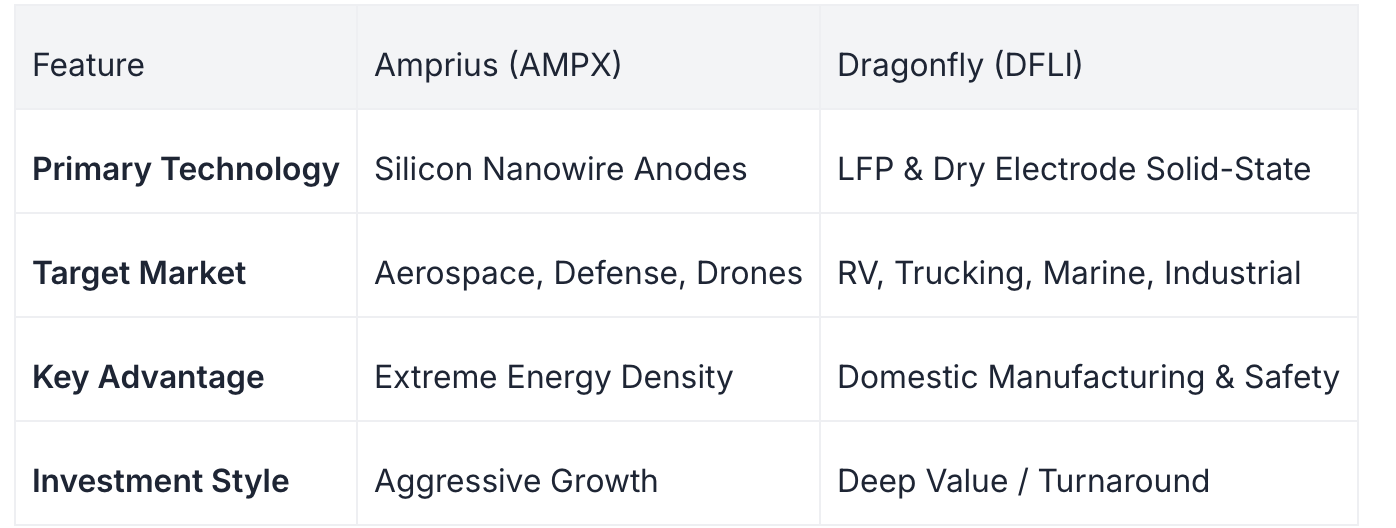
Comparing the Two Contenders
Both companies offer exposure to the lithium theme, but they serve different roles in a portfolio.
Why They Both Win
The “electrification of everything” isn’t a single wave; it’s a rising tide. We need batteries that are light enough for flight (Amprius) and batteries that are rugged enough for long-haul trucking (Dragonfly).
By holding both, you cover the spectrum of advanced energy storage without betting on a single chemistry or a single end-market.
Conclusion: The Era of Specialized Power
The days of buying a generic “lithium ETF” and hoping for the best are over. The market is becoming more discerning. Capital is flowing to companies that solve specific, expensive problems.
Amprius (AMPX) solves the problem of weight. It allows things to fly longer and carry more payload.
Dragonfly (DFLI) solves the problem of reliability. It allows critical infrastructure to operate without idling engines or relying on foreign supply chains.
As you build your watchlist of top lithium stocks 2026, look past the miners. The real value is being created in the labs and factories where raw lithium is turned into advanced power. Both Amprius and Dragonfly are well-positioned to lead this next phase of the energy transition.
Actionable Next Steps
Check the Charts: Look for entry points during market pullbacks. Both stocks can be volatile.
Read the 10-Ks: Dive into their annual reports to understand their specific risks, particularly regarding customer concentration.
Monitor Policy: Keep an eye on U.S. defense spending bills and green energy grants, as both can directly impact these companies’ bottom lines.
Disclaimer: This article is for informational purposes only and does not constitute financial advice. Always do your own research before making investment decisions.